Shipped Across the US
Custom screen printed shirts for teams and bulk orders.
What moves the price on a screen print order, and how to tell if your artwork should be printed another way.
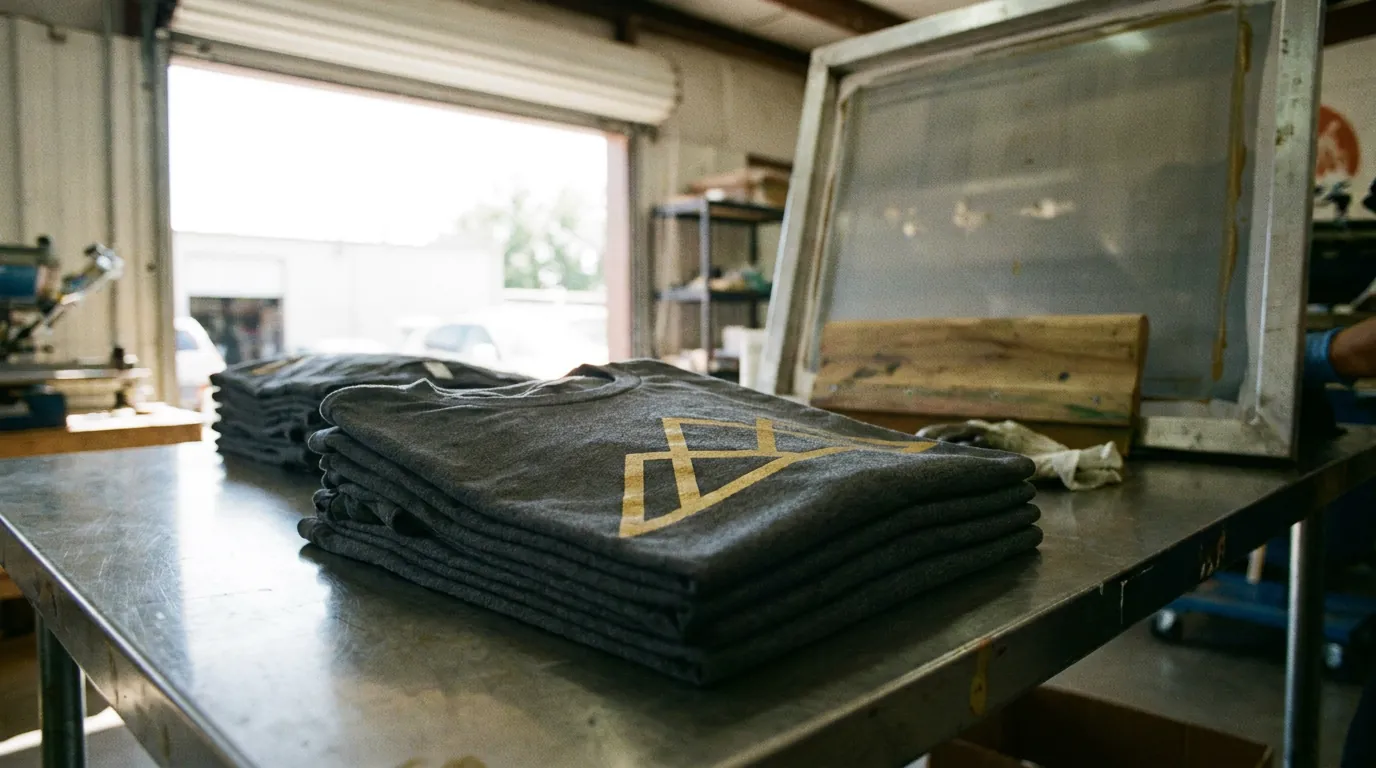
Custom screen printed shirts are decorated by pushing ink through a mesh stencil, with a separate screen for each ink color. The method suits larger runs of the same design, bold graphics, and logos with few colors. Ink colors, print locations, and quantity set most of the price. Bighorn Threads ships screen printed orders to any US address.
What shapes a screen print order
If you want a lower price, these are the levers. Start with ink colors.
| Factor | Why it matters | What to send or decide |
|---|---|---|
| Ink colors | Each color needs its own screen, so a five-color logo costs more to set up than a one-color logo | The final artwork, and whether a design can use fewer colors |
| Print locations | Front, back, and sleeve are each printed separately, and each adds to the price | Every location you want, with rough sizes |
| Quantity | Setup gets split across the run, so the price per shirt drops as the count goes up | Total count and sizes |
| Garment color | Dark shirts usually need a white underbase first, which adds a screen and a heavier feel | The shirt color and whether colors need to match your brand |
| Fabric | Dye in red and heather polyester can bleed into light ink, so those shirts may need a low-bleed ink | The shirt you have in mind, or how it will be used |
| Artwork | Clean vector art separates well. Photos and gradients need a halftone, or DTF instead | A vector file if you have one, or the best version you can send |
Is screen printing right for your shirts?
One design on a lot of shirts
This is what screen printing does best. Staff tees, event shirts, and crew shirts with one design and a couple of ink colors.
Lots of colors or small runs
A handful of shirts or a photo-style design usually belongs on DTF. See DTF vs screen printing.
Small logo on a polo
Embroider it. Print on a polo tends to look like a promo shirt. Compare in screen printing vs DTG vs embroidery.
How the print should feel
Plastisol sits on top of the fabric with a bright, slightly heavy feel. Water-based ink soaks in and feels softer. See plastisol vs water-based ink.
Rough wear and washing
Tell us if shirts will go through industrial laundry. Hot drying is hard on prints, so it changes the ink and shirt we would pick.
Protective garments
FR and hi-vis garments have decoration limits set by their makers. We check them before anything prints.
How to get a real price on the first try
Send the artwork, the number of ink colors, every print location, the shirt, the size count, your date, and where it ships. With those, we can give you a real price on the first try. Sizes 2XL and up usually cost more because the blank shirt does.
If your budget is tight, look at the design first. Dropping an ink color or a sleeve print often saves more than switching to a cheaper shirt.
Choose the shirt for how it will be worn. Soft ringspun cotton suits staff and event shirts. Heavier cotton or a blend holds up better on a crew. Browse the t-shirt catalog, or see what screen printing is if you want the full process.
We only take orders where your logo or design goes on the garment, so we do not sell blanks. For company wear beyond tees, see custom company shirts.
“The order was placed and ready earlier than the date we had discussed. The shipment came right away and everyone loves the shirts.”
How ordering works
- 01
Send the basics
Your logo, the items you want, rough quantities, your date, and where the order ships.
- 02
Get the quote
You get the garments, decoration, price, minimum, and timing in writing.
- 03
Approve the proof
Check the colors, size, and logo placement. Nothing gets made until you approve.
- 04
It ships to you
The order goes to one address or several. We keep your logo file and garment details so a reorder matches.
FAQ
Common questions
What is a screen printed shirt?
A shirt decorated by pushing ink through a mesh stencil onto the fabric, using one screen for each ink color. It is a common method for bulk t-shirts and bold logos.
What is the minimum order for screen printed shirts?
It depends on the shirt, ink colors, and print locations. Short runs get expensive fast because setup is split across fewer shirts, so we may point a small order to DTF. Send your count and art and we will tell you what applies.
What file should we send for a screen print?
A vector file such as AI, EPS, or PDF separates most cleanly. If you only have an image file, send the highest-resolution version and ask whether it needs to be redrawn.
How many colors can you screen print?
Send your design and we will check it, since the limit depends on the art and the press. Past a handful of colors, or with a photo, DTF often gives a better result for less.
Is screen printing better than embroidery?
Print tees and big designs, and embroider polos, hats, and layers with small logos. Many crews do both on one hoodie, with a stitched chest and a printed back.
Can you print on the front, back, and sleeve?
Yes. Each location is printed separately and adds to the price, so list them all when you ask.
How long do bulk custom t-shirts take?
The shirt being in stock and how fast you sign off on the proof matter most. Send the date you need them in hand and we will tell you up front if it works.
Do you ship screen printed shirts nationwide?
Yes, to any US address, and to several addresses on one order.
Send your logo and quantities
We ship anywhere in the US. Tell us the garment, how many, and your date, and we will send a price and a proof.