ANSI/ISEA 107 Hi-Vis Guide: Class 1, 2, and 3 Explained for Vegas Trades
What each hi-vis class actually requires. When you need Class 2 vs Class 3. The 72 sq-in logo placement limit nobody talks about. And the decoration techniques that keep your branding from breaking the cert.
ANSI/ISEA 107 is the standard nobody reads but everybody buys against. The label says "Class 2" or "Class 3" and most shops stop there. The actual standard is a 60-page document that covers background fabric area, retroreflective material totals, color, washing performance, and — the part that trips up most uniform orders — how much of that surface area you\'re allowed to cover with a logo before the garment is no longer compliant.
We decorate ANSI 107 garments every week for Las Vegas trades. This guide is the working version: what each class actually means, when you need it, and how to get your branding on without breaking the rating. If you want the full text of the standard, ISEA sells it. If you want to know how to actually buy and decorate hi-vis correctly, keep reading.
1. What ANSI/ISEA 107 Actually Is
ANSI/ISEA 107 is the American National Standard for High-Visibility Safety Apparel, published by the International Safety Equipment Association. The current edition (107-2020) breaks hi-vis garments into three performance classes based on the minimum amount of fluorescent background material and retroreflective trim, plus a separate "Type" designation that tells you what environment the garment is rated for.
Type O, R, and P
Type O ("off-road") covers workers in environments separated from public traffic — warehouse yards, oil and gas sites, rail yards. Type R ("roadway") covers workers exposed to traffic from public roads, work zones, or construction equipment moving on the site. Type P ("public safety") is for first responders. Most trades work in Vegas falls under Type R.
Background and retroreflective requirements
Each class specifies a minimum square inch area of fluorescent background fabric (the lime, orange, or red-orange you see) and a minimum total area of retroreflective tape. The numbers are based on the smallest size in the run — meaning a Class 2 garment in size Small has different minimums than the same garment in 4XL, but both must meet the floor for their respective class.
2. Class 1 — Parking Lots and Low-Speed Areas
Class 1 is the lowest tier. Minimum 217 sq-in of background material and 155 sq-in of retroreflective trim. Visually, it looks like a hi-vis vest with a single horizontal stripe — that\'s the bare-minimum compliance shape.
Class 1 is appropriate for workers who have full attention from drivers, traffic moving under 25 mph, and ample sight distance — think parking-lot attendants, valet, cart pushers at retail centers, or warehouse staff working in yard areas with controlled traffic.
For most trades work in Las Vegas, Class 1 is too low. We rarely sell Class 1 to anyone with "contractor" in the company name — the moment a service vehicle is on the site or a forklift is moving, you\'re past Class 1 territory.
3. Class 2 — The Trades Default
Class 2 is the workhorse for Vegas trades. Minimum 775 sq-in of fluorescent background, 201 sq-in of retroreflective tape, with the tape arranged in two horizontal bands plus over-the-shoulder striping (or equivalent geometry) so the worker is identifiable from any angle.
Class 2 covers most situations where workers are exposed to traffic moving 25–50 mph or working near moving equipment. That covers virtually every commercial construction site, most utility work, service-truck crews working roadside, surveyors, parking-structure framing crews, and anyone in a Vegas work zone that isn\'t a freeway.
Class 2 garments we stock
Vests, t-shirts (short and long sleeve), polos, and lightweight long-sleeve sun shirts. ML Kishigo, Pioneer, and PIP are our three most-requested brands for Class 2. We carry lime and orange in adult sizes S–4XL, with replenishment cycles short enough that we rarely stock-out for repeat customers.
Practical answer
If you\'re a Vegas commercial trade — electrical, plumbing, HVAC, roofing, solar, framing, drywall, mechanical, oil and gas — Class 2 is your baseline. Buy Class 2 by default, step up to Class 3 only where the work zone or speed demands it. Step down to Class 1 only for non-traffic-exposed indoor work.
4. Class 3 — Highway, Night, and High-Speed
Class 3 is the highest performance level under ANSI 107. Minimum 1,240 sq-in of background material and 310 sq-in of retroreflective tape, distributed to define the full human form — head to ankle visibility from any approach angle.
That coverage requirement effectively forces Class 3 to be a long-sleeve garment with sleeves striped, or a vest worn over a long-sleeve hi-vis layer that meets the geometry. A Class 3 short-sleeve t-shirt isn\'t a thing — the sleeve coverage is part of how the standard achieves the form-defining requirement.
Class 3 is required for work near traffic at 50+ mph, all roadway work in poor visibility (fog, rain, dust), and most night work in or near active traffic. NDOT spec for highway work routinely calls for Class 3, and any serious flagger work in Las Vegas is Class 3 territory.
Class E pants — the missing piece
ANSI 107 also defines a separate "Class E" for hi-vis pants, gaiters, and overshorts. A Class 2 or Class 3 garment combined with Class E lower-body coverage gets you a "Class 3 ensemble" — useful when the work environment requires the highest visibility but the worker can\'t wear a long-sleeve hi-vis top (like FR situations where the FR layer is on top).
5. When Each Class Applies on a Vegas Site
Two questions decide your class: how fast is the nearest traffic moving, and how visible is the worker to the operator of that traffic. Use this as a working table:
- Class 1: Parking lots, retail loading docks, low-speed yard work — under 25 mph, no construction equipment within 10 feet of worker.
- Class 2: All commercial construction sites, service-truck crews, utility work in residential areas, roadside service, anything with equipment movement or 25–50 mph adjacent traffic.
- Class 3: Highway work, night work, flagger positions, any work zone with 50+ mph traffic, low-light conditions (fog, dust storms, rain).
- Class E pants/lower: Add to a Class 2 top to create a Class 3 ensemble where the worker needs high-vis lower-body coverage but can\'t wear a hi-vis long-sleeve.
For Las Vegas specifically: any work on the 215, 95, 15, or any signed state highway is Class 3 territory. Most local arterial work (Sahara, Eastern, Tropicana, Charleston) is Class 2 unless you\'re inside an active work zone with a posted reduced speed. Indoor commercial buildouts can drop to Class 1 if there\'s no equipment movement on the working level — but most superintendents we work with require Class 2 sitewide regardless.
6. The 72 sq-in Logo Placement Limit
Here\'s the part most uniform shops will not tell you. ANSI/ISEA 107 specifies a maximum logo or decoration area on the front and back of a hi-vis garment: typically 72 square inches per side. Cover more than that with non-fluorescent material and you\'ve effectively reduced the background area below the class minimum — the garment is no longer compliant for the class on the label.
That 72 sq-in figure is the working maximum for most Class 2 and Class 3 garments. It accounts for company name, logo, and typical "Safety First" or job-title text on the back. A standard 12" wide x 6" tall back print is exactly 72 sq-in — that\'s why so many compliant hi-vis shirts cap out around there.
Where the 72 sq-in limit applies
The limit applies to non-fluorescent decoration on the high-visibility background. Logos printed inside an existing non-hi-vis panel (like a contrasting-color shoulder yoke) don\'t count against the limit. Reflective heat-transfer logos can be placed on the existing reflective tape without breaking the cert, but they have to be ANSI-compliant reflective material themselves.
What happens if you exceed it
Two things. One: the garment is no longer compliant for its labeled class. Two: in an OSHA inspection or after an incident, the garment becomes evidence that the employer wasn\'t maintaining ANSI-compliant PPE. We\'ve seen contractors get hit on this in post-incident reviews — not the original cause, but a contributing finding.
Why this matters
Print a 14" x 8" company name across the back of a Class 2 t-shirt and you\'ve covered 112 sq-in — 40 over the limit. The label still says Class 2, but the garment isn\'t. That\'s why we cap our standard back design at 12" x 6" on Class 2 unless we\'re working with a garment that has extra background area to spare.
7. Decoration Techniques That Don\'t Break the Cert
You can decorate hi-vis. You just have to do it within the placement budget and use techniques that don\'t damage the background fabric or the reflective tape. Here\'s what works.
Screen printing
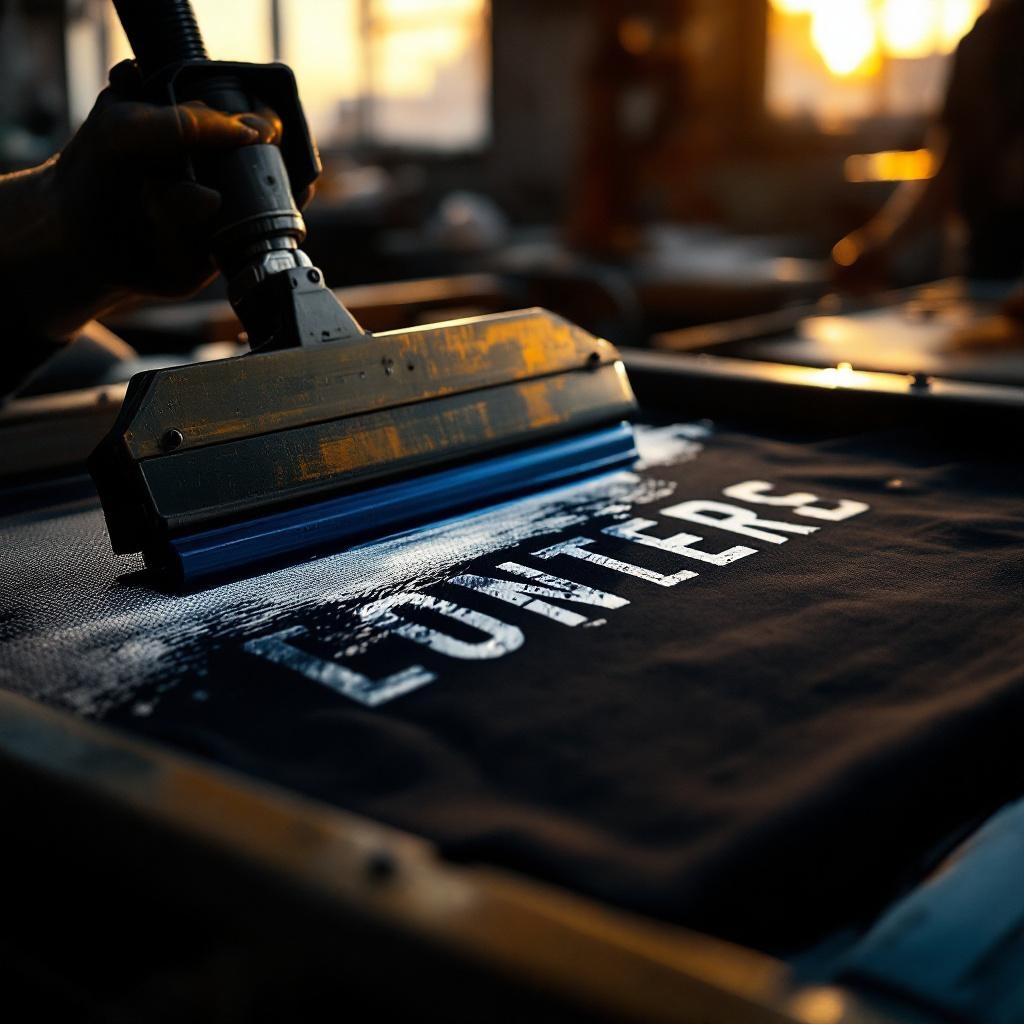
The default for hi-vis. Plastisol ink prints cleanly on lime and orange, holds up through industrial laundry, and lets us hit large coverage areas economically. We screen-print the back logo on most Class 2 t-shirts — keeps the cost down and the design within the 72 sq-in limit. See our screen printing service page for what we run.
Embroidery
Works on Class 2 polos, button-downs, and softshell jackets. Limited on t-shirts because the stitch density can pull the lightweight hi-vis fabric. We use lower-density fills and stable backing for hi-vis embroidery — full embroidery details on our service page.
Heat transfer (HTV)
Useful for small left-chest logos and individual names — applied to the background fabric or to a designated non-hi-vis panel. Avoid heat transfers across reflective tape; the heat can damage the retroreflective beads and reduce performance.
Reflective HTV (special case)
Reflective heat transfer can be used to add company branding without subtracting from the retroreflective area total — because it\'s adding more reflective area. We use this for sleeve striping, badge-style chest logos, and night-work upgrades to standard Class 2 garments.
8. Brands We Trust on Vegas Crews
ML Kishigo
Our default for Class 2 t-shirts and vests. The Brilliant Series mesh tee breathes well in Vegas summer and washes 50+ cycles without losing fluorescence. Reasonable cost per piece, broad size range, lime and orange always in stock.
Pioneer
Strong on Class 2 long-sleeve and Class 3 button-down shirts. Pioneer\'s segmented retroreflective tape (instead of solid) drains better in rain and dust and tends to outlast solid tape on Vegas job sites where dust is constant.
PIP
Industrial-grade vests and Class E pants. PIP tends to be the brand a safety officer specs when they want a recognizable label on every spec sheet. We stock the Bisley Workwear and standard PIP lines.
9. The Short Version
Spec Class 2 as your default for Vegas trades. Step up to Class 3 for highway, night, or 50+ mph adjacent traffic. Cap your back logo at 12" x 6" (72 sq-in) so you stay inside the placement limit. Decorate with plastisol screen print, embroidery on heavier garments, or reflective HTV when you want to add visibility instead of subtract from it.
For a full breakdown of what we make under hi-vis spec, see the related industry pages: electrical contractors, roofing and solar, and general contractors. Or jump to the related compliance guides on NFPA 70E embroidery and Nevada heat-illness rules.
Need ANSI 107 hi-vis for your crew?
Send your roster, the class you need, and your design. We'll send a quote with brand picks and decoration plan.
Get a QuoteFor a side-by-side comparison see Class 2 vs Class 3 hi-vis. We cover sourcing in our custom safety vests with ANSI compliance writeup. When in doubt, upgrade to Class 3 — covers more visibility scenarios.
Bighorn Threads Team
ANSI 107-compliant hi-vis decoration for Las Vegas trades today. We stock ML Kishigo, Pioneer, and PIP — and we keep the spec sheets on file so reorders match. Back to the safety & compliance hub.