NFPA 70E Embroidery Guide: How to Brand FR Shirts Without Voiding the Rating
What "arc-rated" actually means. Why standard polyester thread voids the certification. The exact placement rules per brand. And how a safety officer verifies your decoration on a job-site walk.
We get the same call every month. A contractor sent his crew\'s FR shirts to a generic uniform shop, the shop embroidered them with standard polyester thread, and now the safety officer is refusing to accept the shirts on site. Fifty pieces, three weeks of lead time, and the whole batch has to be redone — because the shop didn\'t know that decoration on FR is a regulated act, not a service add-on.
This guide is the version we wish every uniform shop had read before quoting an FR job. If you\'re a contractor, it\'ll help you ask the right questions before you hand over a a batch of Bulwark to whoever Googles cheapest. If you\'re a shop, this is the playbook we run on every NFPA 70E order.
For a working-electrician\'s view of the broader NFPA 70E standard — CAT ratings, brand picks, what to actually buy — see our companion piece, FR Shirt Compliance for Vegas Electricians. This guide goes deep on the decoration side specifically.
1. What NFPA 70E Covers
NFPA 70E is the National Fire Protection Association\'s standard for electrical safety in the workplace. It defines the apparel and PPE required to protect workers from arc flash and arc blast hazards — events where energized electrical equipment fails catastrophically and releases a burst of plasma, light, and pressure.
OSHA references NFPA 70E as the consensus standard for compliance with 29 CFR 1910.269 (electric power generation, transmission, and distribution) and Subpart S (electrical). In practical terms: if a worker can be exposed to incident energy greater than 1.2 cal/cm², the employer is required to provide arc-rated PPE. That covers most journeyman electrical work in commercial settings.
The key word for our purposes is system. NFPA 70E doesn\'t certify a shirt — it certifies the apparel system the worker is wearing, including the original garment, any modifications, and any layered components. Decoration is a modification. Done wrong, it changes the rating.
2. Arc-Rated vs Flame-Retardant — They\'re Not the Same
"FR" gets thrown around like it means one thing. It doesn\'t. Flame-retardant means the fabric resists ignition and self-extinguishes. Arc-rated means the garment has been tested under arc-flash conditions and assigned a measured thermal protection value in cal/cm². All arc-rated garments are FR. Not all FR garments are arc-rated.
For NFPA 70E compliance, you need arc-rated, not just FR. The label on a compliant garment will show its arc rating in cal/cm² (often 8.7, 12, or higher) and reference NFPA 2112 or ASTM F1506. If the label only says "flame-resistant" or "FR" with no cal value, it doesn\'t meet 70E for arc-flash work.
This matters for decoration because the arc rating includes the assumption that the garment surface hasn\'t been modified with non-rated materials. Stitch a polyester logo across the chest and you\'ve introduced a fuel source into a system designed to not have one. The polyester ignites at temperatures the FR fabric is designed to suppress, and now the rating is effectively void in the area of the decoration.
3. FR-Compatible Thread (Nomex / Aramid)
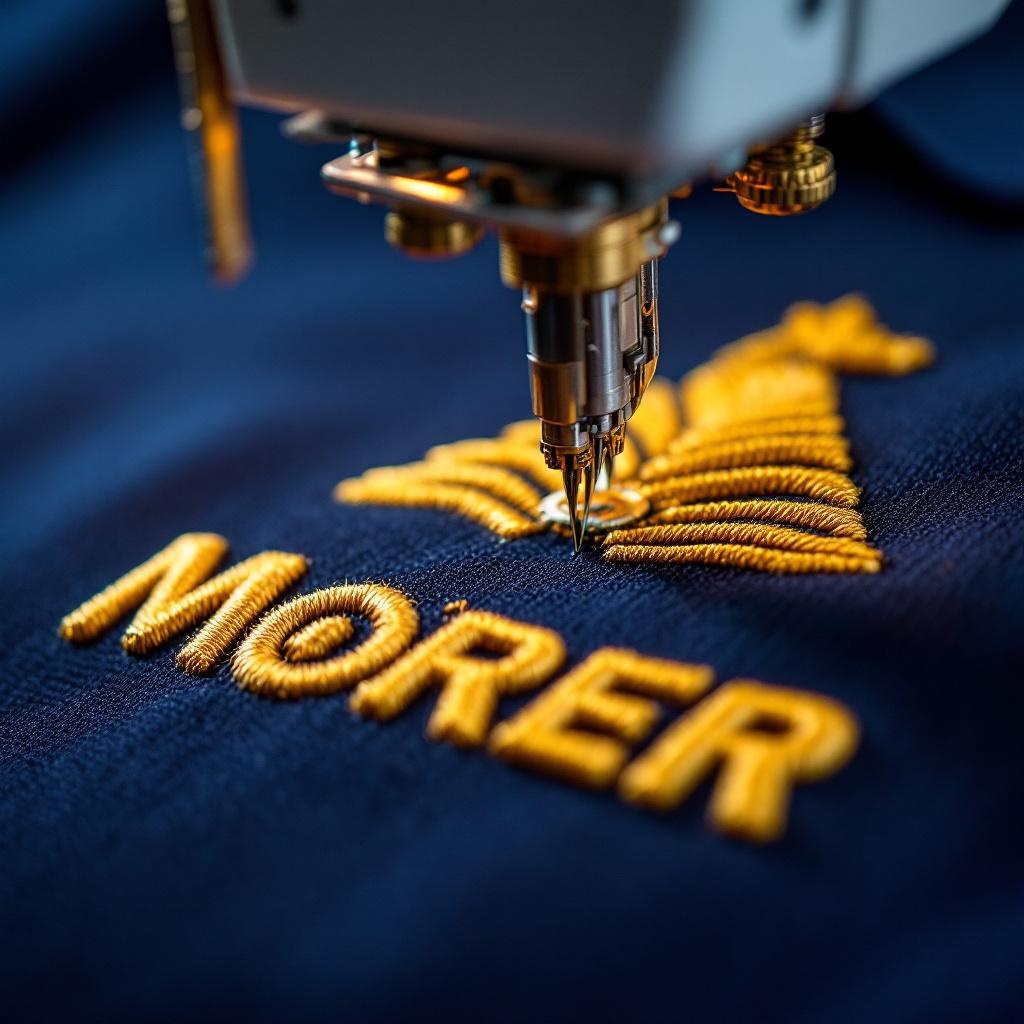
Standard embroidery thread is polyester or rayon. Both are flammable. Both melt under arc-flash conditions. Both are explicitly excluded from FR-compatible decoration by every major FR garment manufacturer. If you\'re embroidering on an arc-rated shirt with anything other than FR-compatible thread, you\'ve failed the modification.
Nomex thread
Nomex (DuPont aramid) is the gold-standard FR-compatible embroidery thread. It\'s inherently flame-resistant — the FR property is in the fiber itself, not a treatment that washes out. Nomex thread is used by every major FR garment decorator we know of, and it\'s the thread we run on every NFPA 70E job in our shop.
The trade-off: Nomex comes in a smaller color library than polyester. Roughly 60–80 standard colors versus the 400+ available in polyester. Brand-color matching can require a Pantone discussion before production. We\'ll work with you to find the closest Nomex match for your logo before we run the job.
Other aramid blends
Kevlar (also DuPont aramid) and several Indian/Korean aramid blends are also FR-compatible. We use Madeira FireFighter and Coats FR threads as alternates when Nomex isn\'t available in a needed color. All are inherently FR aramid, all meet the same standards.
Cotton thread (do not use)
Some shops will tell you "cotton is fine for FR because it\'s natural." It\'s not. Untreated cotton ignites at lower temperatures than the FR fabric is designed to protect against. Cotton thread on FR is not compliant and not safe.
The thread rule
If your current decorator can\'t answer "what thread do you use on FR?" with the words "Nomex" or "FR-compatible aramid," they\'re running polyester. Period. There are no shortcuts here. Ask, verify, and switch shops if the answer is wrong.
4. Placement Spec Per Brand
Every major FR garment manufacturer publishes a decoration spec sheet — exact placement rules for embroidery, screen print, and heat transfer on their garments. The spec varies by brand, garment line, and sometimes by individual SKU. Following the spec keeps the warranty and the certification intact. Ignoring it voids both.
Bulwark FR
Bulwark publishes one of the most detailed decoration spec sheets in the industry. Standard rules for the Excel-FR ComforTouch line: embroidery up to 4" x 4" on the left chest with FR-compatible thread, 12" x 4" name strip on the back yoke, no embroidery within 2" of any garment seam or hem. Heat transfer is permitted with FR-rated transfer film only.
We keep current Bulwark spec sheets on file for every line we run. If you\'re placing a Bulwark order with us, we\'ll verify the decoration plan against the spec before production. If your design exceeds the placement budget, we\'ll either reduce it or recommend a sewn-on FR-rated woven label as an alternative.
Carhartt FR
Carhartt FR spec is similar to Bulwark with a few line-specific differences. The FRSH13 Force Henley allows up to 4" x 3.5" left chest embroidery with FR-compatible thread. The FRK293 button-up allows 4" x 4" left chest plus a 2" x 4" sleeve embroidery on the right cuff. No embroidery on pocket flaps.
Carhartt also requires that any decoration use FR-compatible backing material — a non-FR cutaway backing left in the garment after production is technically a violation. We use FR-rated water-soluble backing that washes out completely, removing the backing question entirely.
Wrangler Riggs FR
Riggs FR spec is the most permissive of the three — typically 4" x 4" chest plus 12" x 4" back across most of the line. Same thread and backing rules apply.
5. Backing Material Requirements
Embroidery requires backing — a stabilizing material placed behind the fabric during stitching to keep the design clean and prevent puckering. On standard garments we use cutaway polyester backing. That backing stays in the garment after production.
On FR garments, polyester backing left in place is non-compliant. The backing introduces a flammable layer behind the FR fabric exactly where the embroidery sits. Two options for compliance:
- FR-rated cutaway backing: Aramid or Nomex backing material, left in place after production. Stays compliant but adds material cost and slight stiffness behind the design.
- Water-soluble backing: Backing that dissolves completely in the first wash. The garment ships with backing in place, customer launders, backing is gone. Our preferred method for most FR jobs.
We use water-soluble backing on the majority of our FR embroidery work. It removes the backing question from the customer\'s side entirely — they wash the shirts before first wear (which their laundry process should already include) and the design is left clean against the FR fabric with no extra material in the system.
6. Screen Printing as an Alternative
Screen printing on FR is possible but more constrained than embroidery. The ink itself has to be FR-rated, the placement spec is typically tighter, and the maximum coverage area is smaller. For most FR work we recommend embroidery — same compliance level, more durable through industrial laundry, and a better fit for the typically smaller logos used on service-call gear.
When screen print on FR makes sense: large, simple back graphics for a crew name or job site, where embroidery would be cost-prohibitive at the size needed. We use water-based FR-rated inks (typically Wilflex FR or equivalent) and verify the manufacturer spec before production. Read more on our screen printing service page.
7. How a Safety Officer Verifies the Decoration
Safety officers don\'t inspect every garment with a magnifying glass. They do a few quick checks on a job-site walk and they ask for documentation when something looks off. Here\'s what they\'re actually looking at:
Visual check on the embroidery
Standard polyester thread has a distinctive sheen that\'s easy to spot once you\'ve seen Nomex side by side. Nomex is matte. If the embroidery is shiny or "plastic-looking," it\'s probably polyester. A safety officer who\'s seen 100 FR shirts knows the difference at five feet.
Burn test (if it gets serious)
For high-stakes verification — post-incident review, large utility customer audit — a safety officer can have a small thread sample tested at a third-party lab, or perform a quick controlled-flame test on a thread sample to see if it ignites or self-extinguishes. Polyester ignites and burns. Nomex doesn\'t.
Documentation request
The cleanest verification: the safety officer asks the contractor for the decoration shop\'s certification or invoice line specifying FR-compatible thread. We provide this documentation on every NFPA 70E order. If your current shop can\'t produce it, that\'s the answer.
Placement check against manufacturer spec
Less common but valid. A diligent safety officer can pull up the Bulwark or Carhartt spec sheet for the garment and measure the actual decoration. If your logo is 5" wide on a Bulwark shirt with a 4" max, that\'s a documented non-conformity.
Why this matters
A safety officer\'s job is to find the documentation gap, not to be helpful. If the wrong thread is on a shirt during a routine walk, that\'s a write-up. If it\'s on a shirt during a post-incident investigation, it\'s evidence the employer didn\'t maintain compliant PPE. The decoration shop won\'t be in the room — the contractor will.
Need FR shirts decorated correctly?
Send your roster, brand spec, and logo. We verify against the manufacturer spec sheet and send a quote
Get a Quote8. The Short Version
Use FR-compatible thread (Nomex or aramid) on every NFPA 70E job. Verify the placement against the manufacturer spec sheet — Bulwark, Carhartt FR, and Wrangler Riggs each publish their own. Use water-soluble or FR-rated backing material. Document the decoration method on the invoice so the contractor can produce it during an audit.
For the broader NFPA 70E picture — CAT ratings, brand selection, the five compliance mistakes we see weekly — see our working contractor\'s NFPA 70E guide. For ANSI/ISEA 107 hi-vis decoration rules, see the hi-vis guide. To see what we make for electrical and oil/gas crews specifically, see our electrical contractors and oil, gas & mechanical pages.
More on FR for specific applications: Bulwark FR shirts in Vegas heat, welder uniforms — FR shirts for Las Vegas welders, and the NFPA 2112 FR coveralls buyer guide.
Bighorn Threads Team
FR-safe embroidery for Las Vegas electrical, oil, gas, and mechanical contractors today. Nomex thread, manufacturer spec verification, decoration documentation on every order. Back to the safety & compliance hub.